The Éric novel Bénédicte read
L'Amour et les ForêtsThe Éric novel Bénédicte read is an unnamed book by Éric Reinhardt that becomes a turning point in Bénédicte Ombredanne’s struggle to recover a sense of possibility. After the fragile hope she found at Sainte-Blandine collapses on her return to an arid and isolating marriage, the novel gives her a new source of light: it helps her raise her head, believe in herself, and want to re-enter reality and be happy. Its power is intimate rather than public, and its effect eventually brings the author into contact with her twin, Marie-Claire Ombredanne.
A Book That Reopens the Future
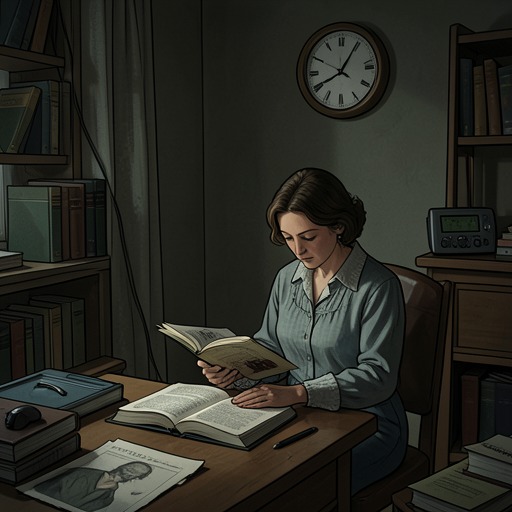
During her two weeks at Sainte-Blandine, Bénédicte imagined that leaving the clinic would coincide with the beginning of a beautiful, surprising life. She pictured calling Christian, living with him, and perhaps having children. But when she left, the brief, euphoric prospect seemed to shut like a trapdoor: her husband’s indifference restored the same bodily loneliness and cold weight she had known before her admission. She describes the life imposed on her as a cellar in which she spent months weeping.
In September 2007, reading Éric Reinhardt’s novel brought light back into that darkness. The change is specific: Bénédicte says that she straightened her head, began believing in herself again, and recovered the desire to fight, return to reality, and be happy. The book does not erase the conditions that had confined her, but it helps her imagine herself as someone capable of moving beyond them. In her account, reading is the impulse that lets her lift the trapdoor and emerge from the cellar.
Private Recognition and the Twin’s Question
When Éric Reinhardt later meets Marie-Claire Ombredanne in Reims, he learns that the book had been recommended to Bénédicte by her bookseller, who thought she would like it. Bénédicte had liked it enough to write an admiring letter to its author. Yet Marie-Claire, her twin sister, had never heard of the book from her, despite believing that the two sisters had always kept no secrets from one another.
Marie-Claire asks what the novel was about and why Bénédicte had valued it so much. Reinhardt suggests that it may have touched something deeply intimate in her, as books sometimes do. Marie-Claire acknowledges the possibility only faintly. The exchange leaves the book’s precise subject and the particular point of recognition unstated; what is established is the disparity between Bénédicte’s strong response and her silence toward the sister who thought she knew everything about her.
The Book Passed On
After hearing about Bénédicte’s admiration, Reinhardt offers to find a copy in a Reims bookshop and give it to Marie-Claire that evening, with a dedication. She agrees. Their conversation has taken place while she is working as an esthetician and removing a hydrating mask from his face; before they part, they exchange telephone numbers and arrange to choose a quiet restaurant where they can speak without being disturbed by noise or nearby tables.
The novel thus passes from Bénédicte’s private reading into a meeting between the author and her twin. Its role is not simply that of a celebrated or widely familiar work: Reinhardt explains that his reputation is limited, and that the book had succeeded without making him a household name. For Bénédicte, its consequence was personal and consequential, a renewed wish to live; for Marie-Claire, the offered copy becomes a way to approach a part of her sister’s inner life that Bénédicte had never shared with her.